
Which Legal Trends in 2025 Are Big Firms Ignoring and How Small Law Firms Can Take Advantage
Which Legal Trends in 2025 Are Big Firms Ignoring and How Small Law Firms Can Take Advantage
Big law firms are racing to adopt AI to replace outdated processes like document review, research, and junior staff tasks - but it won't happen overnight. For solo attorneys and small to mid-sized firms, 2025 and early 2026 offer a rare chance to grab a competitive edge.
Ready to transform your legal practice with AI-powered tools, agents, and chatbots that cut costs and enhance efficiency? This guide dives into the most practical AI solutions for lawyers - highlighting their benefits, challenges, and compelling case studies. Explore how AI is already reshaping the legal field by streamlining administrative tasks and managing documents, with real insights from legal professionals (statistics) and a focus on the practice areas set to gain the most.
Let’s get started!

Automating Legal Tasks with AI
AI tools like CoCounsel (Thomson Reuters) and ROSS Intelligence can analyze mountains of legal documents in minutes, freeing you up for strategic work. But many AI models are trained on copyrighted content, raising legal questions.
In a landmark Delaware court case, ROSS Intelligence was found to have violated Thomson Reuters’ copyrights. This sets a precedent that could impact OpenAI, Microsoft, and others.
How AI Is Changing Legal Work Now
Whether you’re ready to implement one of the solutions below or not, you can start almost immediately. Before diving into specific AI tools, it’s best to get hands-on experience with the most essential ones, like: OpenAI’s ChatGPT, Google Gemini (formerly Bard), Microsoft Copilot, Anthropic’s Claude or IBM Watsonx.
- Speedy Document Analysis: AI rapidly processes legal texts, highlighting key points and cutting manual work. But beware—relying on basic chatbots has led to disasters, like lawyers citing fake cases or using flawed AI tools like LEAP that fabricated legal citations.
- Accurate Precedent Searches: Used responsibly, AI can revolutionize legal research by finding the right case law fast, saving time and improving accuracy.
- Contract Automation: AI reviews contracts, flags risks, and aligns with your firm’s standards. Customizable tools can fit your unique legal practice.
In this short video, we’ll introduce the top 4 AI legal tools revolutionizing 2025—and beyond!
Reviews of 9 AI Tools for Lawyers and Legal Assistants
The legal tech landscape is expanding rapidly, with AI tools built on OpenAI, Google, and other advanced models now tailored specifically for legal professionals. Below, we dive into nine AI-driven platforms that lawyers across the U.S. are using daily - along with their strengths and shortcomings.
1. Robin AI
Robin AI streamlines contract drafting and review, offering templates, AI-powered edits, and key clause extraction. Reddit users appreciate its intuitive interface, making digital document management more accessible. However, integrating it with older legacy systems can be a challenge.
- Speeds up contract documentation.
- Reduces manual work and saves time.
- Adaptable for both small and large firms.
- Requires human oversight to prevent errors.
- Some users note room for improvement.
2. Harvey AI
Designed for large law firms, Harvey AI excels at analyzing contracts, identifying clauses, and extracting key terms. Glassdoor users appreciate its predictive analysis, though it struggles with niche legal areas.
Harvey Legal AI excels at quick legal research and case summaries but falls short in complex legal analysis, lacking the depth and strategic insight needed for nuanced legal matters.
- Enhances efficiency, freeing up time for strategy.
- Quickly identifies relevant clauses.
- Supports multiple languages and predictive analysis.
- Custom pricing may be prohibitive for smaller firms.
3. CaseText
Powered by GPT, CaseText assists with document review, legal research, and contract analysis using NLP and Boolean search. While it integrates seamlessly into workflows, some users warn of irrelevant results in complex queries.
One user praised CoCounsel’s GenAI legal research tools (now part of Westlaw Precision) but found its document review cumbersome, requiring large data transfers that made the process inefficient.
- Speeds up document analysis and risk assessment.
- Improves legal research efficiency.
- Still requires human review for accuracy.
Casetext offers precise case law research, but Carolyn Elefant’s review notes it lacks ChatGPT’s broader flexibility for quick insights, highlighting a trade-off between depth and versatility.
4. Paxton AI

Paxton AI specializes in legal research, drastically cutting down the time spent finding relevant case law. Users appreciate its speed and customizable search criteria, though some features still need refinement. Review here.
- High accuracy (up to 94%).
- Cost-effective for firms of all sizes.
- Some features still need fine-tuning.
Boolean search generation helps streamline contract analysis, though it may require manual tweaks for specific cases.
5. Research Rabbit

Dubbed the “Spotify for research,” Research Rabbit helps legal professionals find and visualize citation networks. Users appreciate its intuitive visual mapping, but results depend heavily on the quality of uploaded sources.
- Accelerates literature reviews.
- Improves citation navigation.
- Recommendation accuracy varies based on input data.
6. Chat PDF

This tool lets users interact with PDFs by asking questions and generating summaries. While it simplifies complex documents, accuracy can drop with poorly formatted PDFs.
- Quickly summarizes legal documents.
- Simplifies complex information.
- Performance varies based on PDF formatting.
- Limited to PDFs, restricting its use cases.
7. Trinka
Trinka is an AI-powered proofreader tailored for academic and legal writing. It excels at catching minor errors and refining style, though some find its suggestions too rigid.
- Detects subtle grammar and style issues.
- Offers a free version for shorter texts.
- Advanced features require a paid subscription.
Ideal for legal and academic writing, but its tone adjustments and premium-only advanced features might not suit everyone.
8. Consensus
An AI search engine for peer-reviewed studies (research), Consensus filters out marketing-heavy content. It’s particularly useful for lawyers in regulatory law, compliance, and litigation.
- Provides quick access to credible sources.
- Filters out non-academic content.
- Lacks depth for certain legal queries.
9. Copyleaks
Copyleaks is a real-time plagiarism checker that scans billions of sources. Users find it fast and effective, often comparing it to Copyscape’s earlier dominance in content verification. Copyleaks is particularly useful for any trademark and copyright attorney, ensuring originality by scanning billions of sources.
- Thorough and rapid originality checks.
- Pay-per-report model suits occasional users.
- Extensive checks require a paid version.
Either Copyleaks is ridiculously accurate, or the other ones are extremely inaccurate. Other User: No, it flagged my 2 year old essays as AI :(
2025: Small Firms Lead the Way as Big Players Hesitate
A concise yet insightful article from abajournal sheds light on how the legal industry worldwide, not just in the U.S., is embracing AI. Although the survey included only 212 lawyers, it clearly signals growing interest in AI-driven innovations within the legal profession.
- 32% of law firms and 20% of in-house legal teams are already using or planning to adopt AI.
- 48% cited heavy workloads as their biggest challenge, while 46% believe AI will shape the future of law.
- 60% are focusing on smaller tech initiatives like contract management, compliance, and risk management.
- 31% view improving efficiency as a key challenge, while 32% highlight the importance of high-quality document review.
- Survey of 212 lawyers from the U.S., Europe, Asia, and Australia (July–August 2024).
“Without AI, keeping up with the workload will be impossible,” – Michael Pontrelli, Consilio.
Rapid Growth in AI Adoption, Yet Untapped Potential Remains
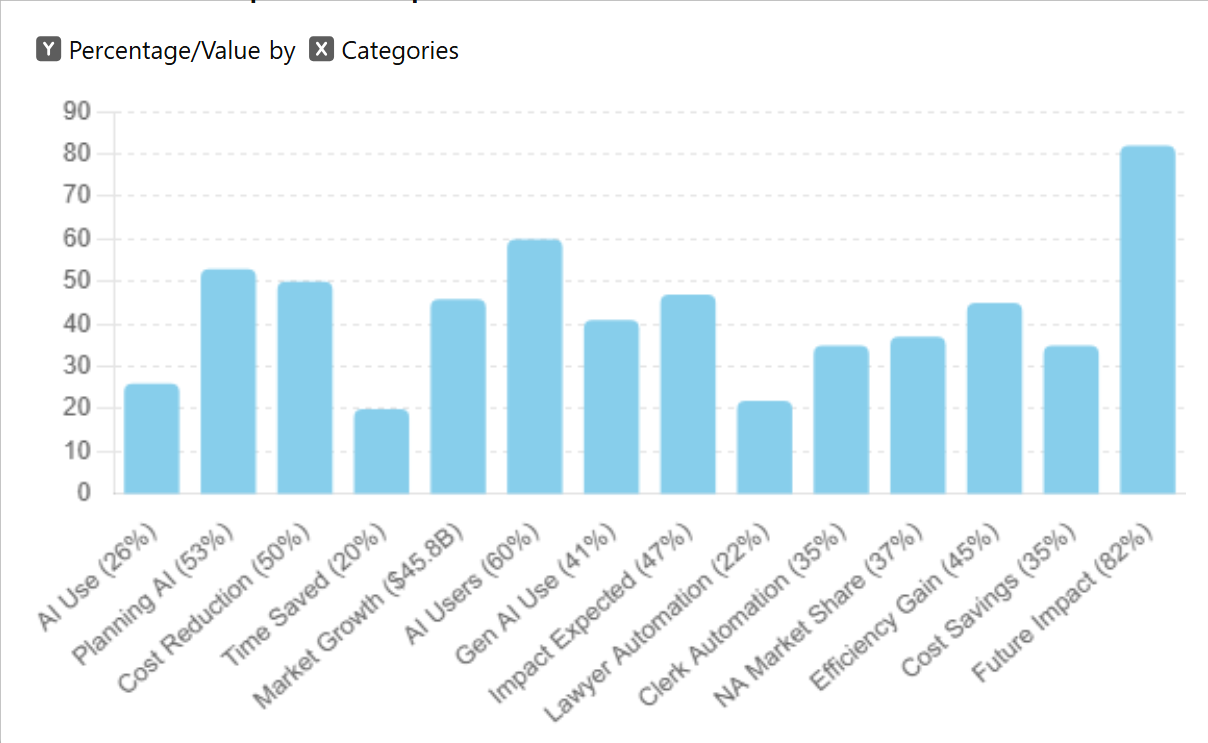
- AI Adoption: 26% of law firms currently use AI, and 53% plan to invest in it.
- Efficiency Gains: AI can cut costs by up to 50% and save lawyers 20% of their time on routine tasks.
- Growth Forecast: The legal AI market is projected to reach $45.8 billion by 2030, with a CAGR of 32.5%.
- AI Integration: 60% of lawyers already use AI, 41% have adopted generative AI, and 47% believe AI will transform legal practice.
- Automation Potential: McKinsey estimates that 22% of lawyers' tasks and 35% of paralegals' work can be automated.
- Regional Leaders: North America leads with a 37% share of the legal AI market.
- Key Benefits: 45% of lawyers report improved efficiency, while 35% see reduced costs.
- Future Impact: 82% of lawyers expect AI to significantly reshape legal practice within 5–10 years.
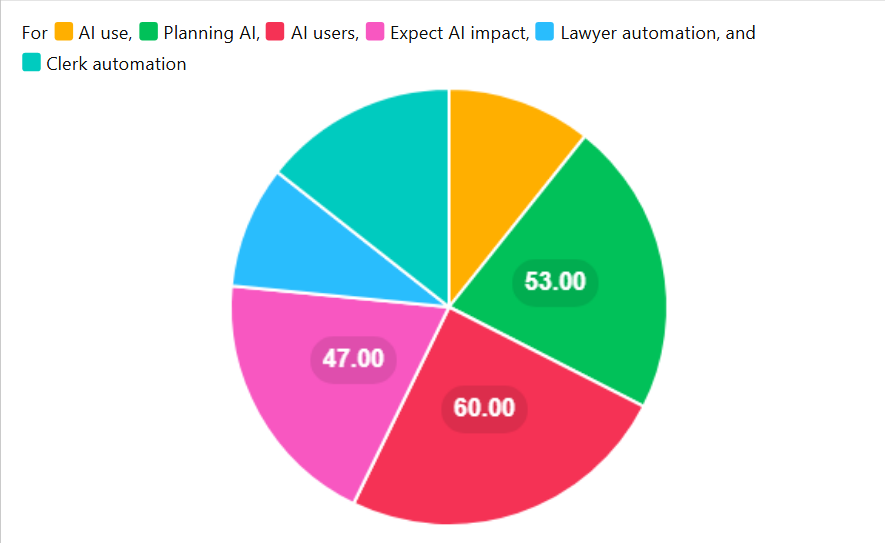
Sources: Thomson Reuters, Statista, ABA Journal, McKinsey, Gartner, Law.com, Florida Bar.
Real-World AI for Lawyers
From CoCounsel and Lawgeex to Harvey AI, AI can save hours—but integration costs from $100s to $1000s/month. Over-reliance is risky: you depend on vendors, updates, and legal adaptability.
AI cuts costs but isn’t foolproof. Deep integration means relying on developers for updates and legal compliance.
Tools like DoNotPay act as a “lawyer in your pocket” for small tasks but still need human oversight, which can be challenging for small firms.
DoNotPay was fined $193,000 for misleading claims about its AI’s legal capabilities—proof that AI misuse has real consequences.
Let’s dive into the top AI tools already revolutionizing legal work—from precedent searches and document reviews to mergers, acquisitions, and legal research.

| Tool | Key Uses |
|---|---|
| CoCounsel | Instant database searches to find crucial legal information fast. Automated document review with clear summaries for quick insights. |
| ROSS Intelligence | Fast, accurate precedent searches. Quick legal query analysis for complex questions, saving hours of research. |
| Harvey AI | Auto-generates contracts compliant with current laws. Analyzes legal strategies with tailored recommendations. |
| Lawgeex | Automates contract review, ensuring compliance with firm standards. Identifies risky clauses and suggests fixes. |
| Lex Machina | Predicts litigation outcomes based on past case data. Analyzes judge and opponent behavior for better case prep. |
| Kira Systems | Extracts key data from contracts for due diligence. Speeds up M&A document review. |
| DoNotPay | Automates minor legal tasks like disputes and refunds. Flagged by the FTC for misleading AI claims. |
| Luminance | Uses machine learning for contract pattern recognition. Audits contracts for compliance and irregularities. |
| Juro | Automates contract creation, approval, and storage. Enables real-time contract collaboration online. |
| Casetext | Performs rapid legal research. Generates precise legal citations automatically. |
Real Stories: Lawyers on Reddit Embrace AI
Lawyers on Reddit call AI their “unpaid intern”—handling tedious tasks like drafting, scheduling, and research fast. But they know the risks: AI is a great helper but a dangerous master without oversight.
AI often fabricates legal data—inventing precedents, misquoting laws, and offering misleading advice. Cases in the US and Australia prove that blindly trusting AI can result in fines, delays, and malpractice claims, even for seasoned attorneys.
Reddit user PepperoniFire relies on AI for routine work but never for sensitive tasks. downthehallnow says AI citation tools have improved but still need careful checks. Meanwhile, lawburner1234 warns that even AI trained on legal data can “hallucinate,” making it risky for legal analysis. The takeaway? Lawyers are using AI but remain cautious.
In the next video, Enrico Schaefer from Traverse Legal, PLC will share his top 5 AI tools!


Top Legal Fields Benefiting from AI
AI is reshaping legal practice, especially in fields that manage large document volumes or require precise legal analysis, such as:
- Corporate Law: Streamlines due diligence and contract review, saving countless hours.
- Litigation: Enhances precedent searches and court document analysis with unmatched speed.
- Mergers & Acquisitions: Efficiently reviews contracts and flags critical terms.
- Employment Law: Tracks legal updates and analyzes employment agreements swiftly.
- Compliance & Regulation: Automates compliance checks, reducing legal risks.
How AI Is Empowering Car Accident Lawyers
AI is transforming personal injury law, especially in car accident cases, by cutting costs and boosting accuracy. Attorneys use AI to review medical records, reconstruct accidents, and estimate claim values quickly and reliably. Justpoint raised $45 million to build AI tools that analyze medical data and detect harmful drugs, driving product liability cases forward.
EvenUp, now valued at over $1 billion, offers an AI platform that helps lawyers draft and refine legal documents, ensuring precision and maximizing compensation for accident victims.
Will AI Replace Lawyers?
The debate is ongoing, but one fact stands: AI will become a cornerstone of law firms and legal education. Attorneys adopting AI tools - even for basic administrative tasks - gain a powerful competitive edge.
AI won’t replace lawyers anytime soon, but those who ignore it risk falling behind in efficiency, cost management, and client service.
Key AI Advantages in Law:
- Speeds up case law searches, contract analysis, and document preparation.
- Assists pro se litigants in gathering evidence and navigating court processes.
- Handles routine client inquiries through chatbots, freeing up lawyers' time.
AI Challenges and Limitations:
- AI can “hallucinate,” creating fake precedents that could derail cases.
- It lacks the human touch—social, political, and cultural context is often lost.
- AI can’t replace human intuition, experience, or negotiation skills crucial for legal success.
The Future of AI in Law:
AI will likely automate support roles like paralegals, while the nuanced work of attorneys remains irreplaceable. Lawyers who ignore AI risk obsolescence - much like those who once dismissed email. However, challenges persist: AI depends on accurate, up-to-date data to avoid errors, and it often misinterprets the complexities of legal analysis. A balanced approach that combines automation with human oversight is key to maintaining quality and ethical standards.
- AI is likely to replace support roles like paralegals, but not attorneys.
- Lawyers resisting AI risk becoming obsolete, much like those who rejected email in the past.
- Current concerns revolve around data reliability and AI’s misinterpretation of complex legal matters.
Share Your AI Experience! If you're a lawyer using AI tools, we want to hear from you! Share your firsthand experiences and insights in the comments below or directly on your profile. Nothing is more valuable than personal perspectives on how specific tools perform in real legal practice. Your knowledge could guide and inspire others...
Legal professionals have observed that AI tools can significantly enhance many legal processes—from automating contract reviews to streamlining precedent searches. However, integrating AI into legal practice also introduces several important ethical and practical challenges. The costs of implementing and maintaining these systems can be considerable, especially for smaller law firms that may struggle with the expense. Furthermore, data protection remains a significant concern, as sensitive legal information could be at risk if an AI platform’s security measures are inadequate. Additionally, because these models are trained on historical data, they may inadvertently incorporate biases that affect legal analysis and decision-making. In the absence of transparent cost-benefit studies, many attorneys remain uncertain about the return on their investment. Moreover, there is a potential risk of AI systems generating fictitious legal precedents, which underscores the continued necessity for human oversight. As one experienced lawyer noted, "No machine can replace human judgment in maintaining ethical standards and ensuring quality service."
- AI can streamline legal processes, though it also raises ethical considerations.
- The cost of implementing AI remains a significant challenge for smaller firms.
- Data protection and privacy continue to be critical issues.
- Biases in AI models may influence legal decision-making.
- Transparent cost-benefit analyses for AI in law are still lacking.
- The risk of fictitious precedents highlights the need for ongoing human oversight.


Share Your Opinion!
Want your comment to stand out? Logged-in comments are more trusted and make a bigger impact! Sign in with Google to join the discussion and share your thoughts about Which Legal Trends in 2025 Are Big Firms Ignoring and How Small Law Firms Can Take Advantage. It only takes a moment to register or log in. Your voice matters!
Write a Comment!